Desert Southwest
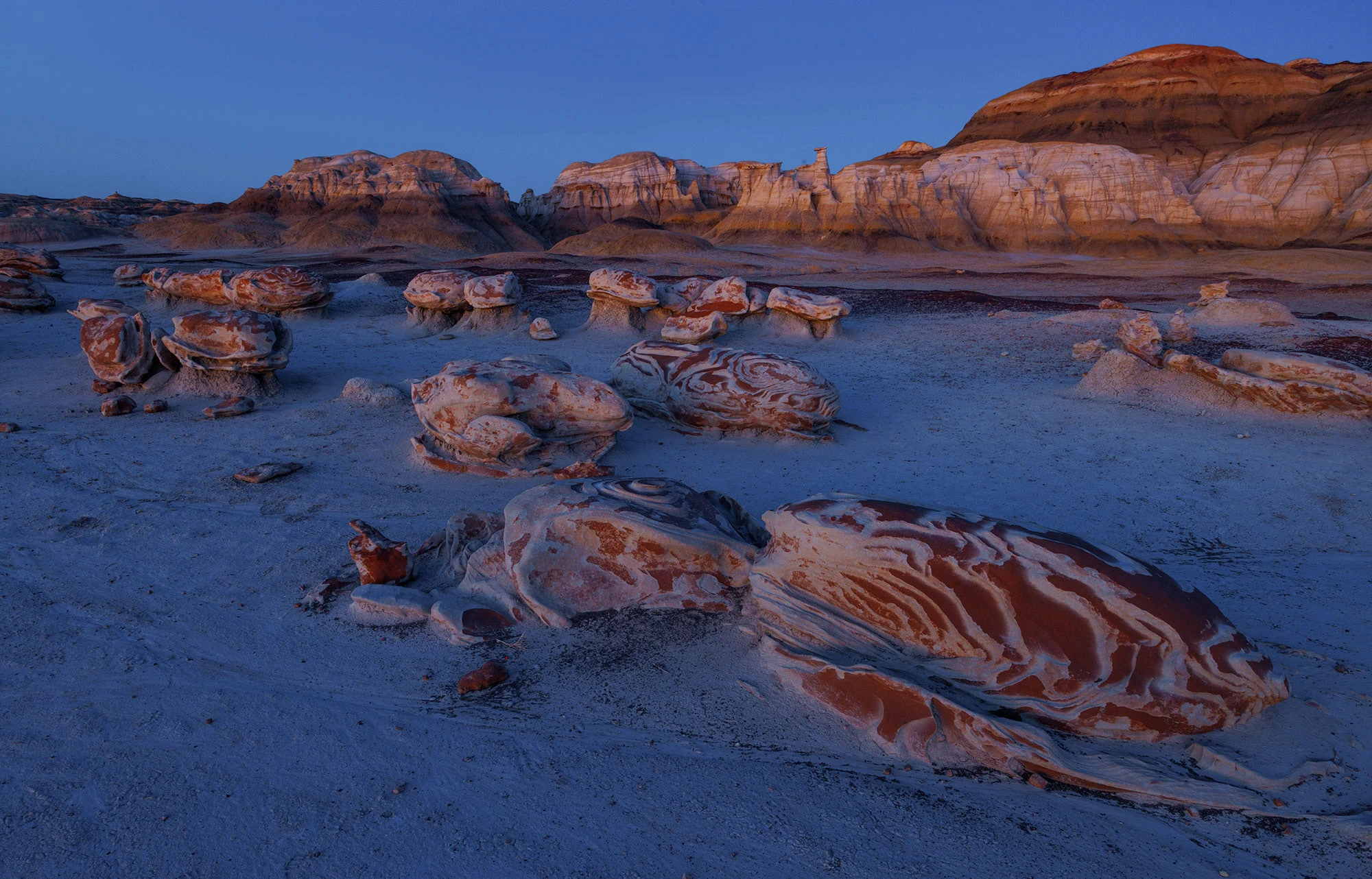
Edge of the
Bisti Badlands
A night hike in the Bisti/De-Na-Zin Wilderness reveals one of Earth's best windows into the Cretaceous.
B
rian and I are on our second night of walking in the Bisti/De-Na-Zin Wilderness of northwestern New Mexico, a badlands of ancient mud that exposes the Late Cretaceous.
The Bisti Badlands are vast and strange, a place almost entirely devoid of life. Once inside, it's easy to become disoriented as there are few landmarks, only endless ridges and gullies that fold into one another. Last night, Brian and I entered from the main parking lot, but tonight we’re entering from the northern lot, slipping into a tighter, more complex system of washes and corridors. We rely on two separate offline GPS maps. As long as one keeps tracking, we figure we can find our way out—even in pitch darkness. Still, even with both maps working, we lose our bearings—circling and never finding the formations we meant to see.
Brian keeps pointing to a recurring pattern in the rock: fractured, fibrous ridges that, to him, look like petrified wood. At first I think he’s overreaching. But as we see more and more of them—some still half-buried, others splayed across bentonite slopes, it becomes more likely that we’re walking among ancient trees, long fossilized, their forms etched in stone.
As these badlands appear to be made of sun-baked mud, rarely reaching a hundred feet in elevation over the ground floor, it’s easy to ignore their history. After all, this isn’t the Grand Canyon, with its towering walls and exposed epochs laid out like an open book. These badlands are low and eroded—easy to overlook, but far older than they appear.

W
hat we're seeing here is something uniquely rare: a landscape where you can stand eye-to-eye with a 75-million-year-old land. Bisti is so undisturbed, that when you walk here, you literally walk through primeval swamps and bone graveyards of a prehistoric time.
Only a few other places in the world expose the Cretaceous epoch like Bisti, but all of those have their limitations. While Grand-Staircase Escalante exposes the same time, examples are scattered in remote locations. Dinosaur Provincial Park in Alberta is covered with vegetation and limitations on access, and the Hell Creek Formation in Montana and the Dakotas is spread out over private land. The Gobi Desert in Mongolia’s exposure is remote and almost always covered by shifting sand dunes.
But here, in the Bisti Badlands, there are dozens of clues in the mud and rock that suggest seventy-five million years ago. Everywhere you go are coal seams; these are ancient deposits made from layers of sandstone, shale, coal and mudstone. Each layer erodes away at a different rate, creating unusual formations like hoodoos and wings.
In these shallow canyons, you can’t help but recall the Star Wars Mos Eisley Cantina Band song, or C3PO and R2D2 on Tatooine: "I've just about had enough of you. Go that way! You'll be malfunctioning within a day, you nearsighted scrap pile!"
But what if we didn’t borrow from science fiction at all? What if, instead, we imagined this place exactly as it was—75 million years ago? Not one rooted in our imaginations of distant galaxies, but in historical fiction. What if we could set a historically accurate scene from 75 million years ago?
I admit to it being difficult for me to peer into the past in a place like this. Recently, though, I kept visiting Tule Springs Fossils Beds in North Las Vegas, the newest National Monument in the United States. I learned there that, through repeated visits and constantly looking under feet, you can start to ‘see’ the place a rocky badlands once was.
In my first visits to Tule Springs, I couldn’t make sense of all the bits of random rock littered across the desert. But when my son targeted the sidewall of a wash, exposing undisturbed layers of rock, he found the perfect fossil impression of repeating circular patterns. We spent a month asking around, and eventually discovered the photographs we took of this fossil depicted a 200,000 year old coral. After that, weevil cocoons, coprolites and gastropods started to become easy to identify. Through a little persistence, Reddit threads and naturalist friends, we could almost visualize Tule Springs.

If Tule Springs represents 200,000 years ago, then the Bisti Badlands take us back 374 times further. This specific spot may have actually been one of the most remarkable scenes in North America’s history. A mysterious landscape of incredible beauty. What if Brian and I were walking around the Bisti Badlands 75 million years ago?
The air would be breathable, but the planet would be teeming with parasites, bacteria and other pathogens that would be completely foreign to our modern selves. Exposing ourselves to this environment would be certain death. Even a single spore or mosquito bite could doom us. So, naturally, were we to visit the ancient Bisti that is exposed on our walk, we’d need to do so in air-conditioned biohazard suits attached with rebreathers and scent suppression mechanisms.
The water, though abundant, would be filled with pathogens, and therefore undrinkable, so we would be carrying our own supply. Because we would be visiting the Bisti region for several days, carrying our water on our backs, on top of the heavy air-conditioning gear, would be unthinkable. Tethered to our hips would be amphibious fat-tired canoe-shaped pulka carts, carrying water, food and shelter.
W
e would be dropped in, or appear in, or walk through a time-travel door - that part is for you to make up - into a vast lowland delta. Although we cannot see it from here, we are near the Western Interior Sea. This giant 2,500 mile long, shallow inland sea split North America in half. At this point in history, it was so large it extended from the Arctic Ocean to the Gulf of Mexico. Crossing it to reach the Eastern United States would be like sailing across today’s Bering Sea.
The first thing we notice even through the filters of our rebreathers is the smell, which is mostly familiar, although intense. It’s the smell of pine resin, mud and swamp, the sharp green of decaying cycad leaves, the ammonia of nearby stagnant pools and the damp smell of fungal rot and decaying leaves.
Then, we comprehend where we are, surrounded by endless placid rivers, milky brown in silt and clay moving with the tides. Between these delta water bodies are thick clumps of ferns, and early ancestors of angiosperms, evolutionarily experimenting with flowers. Along the banks would be spindly Archaefructus plants, complete with odd little flowers. Maybe they are a greenish-blue color, and shaped like bells. In the drier parts might be Platanaceae trees, and in the water, early forms of plants from the water lily family — Nymphaeales — encrusting the water edges with green.
Perhaps the most common plant, permeating nearly every terrestrial inch of the understory are a blanket of Cladophlebis ferns of a hundred species — erect, waxy long fronds punctuated by stubbier triangular fronds and even paddle-shaped leaves, reaching for the sun.
In the distance are hammocks — higher elevation mounds of dense foliage—and magnificent trees. Monocotyledons , early palm-like trees, stick out at the edges of the small islands, and in the center grow dense stands of Zingiberales — broad-leaved plants reminiscent of modern bananas and gingers. At the center of these island hammocks are metasequoias rising more than a hundred feet in height.
These ancestors of sequoias (one metasequoia , a common garden tree, exists today) evolved at more northerly latitudes, and because leaves would be inefficient in the darkest days of winter, the metasequoia was among the first genus to experiment with shedding its leaves — not because of cold weather, as the north then was hot even in winter — but because of the lack of winter light.

T
aking in this scene, it would be a few minutes before we would notice the dime-sized ticks, the palm-sized wasps and the crane-fly sized mosquitos clinging to our biohazard suits and contributing to a chorus of sustained buzzing sound.
Our goal will be to haul our pulkas to the coast, where we will set up camp, but walking is nearly impossible here; water is everywhere and most dry land is thick with foliage. Luckily, our pulkas double as awkward kayaks, and we can safely paddle to the large estuaries that resolve out of these rivers.
While paddling, we begin to see shadows in the murky water. These are turtles, one of them, Denazinemys nodosa , named for this very region, the Bisti/De-Na-Zin Wilderness. Its triangular carapace is heavily armored, and it swims slowly. Clam-like ostracod crustaceans and ancient mussels grow everywhere, especially encasing the buttressed bases of ancient semi-aquatic cypress trees. Crayfish dart among these trees, and huge-eyed megaloptera larvae crawl slowly out of languid eddies.
Now, since this is a historical fiction, you might think we need some drama, and so you might think this is where I yell over at Brian and tell him to paddle ahead while I check out some amphibians along the banks.
I would have to write this part cleverly. Maybe something like, “The water beneath Brian bulges, lifts—not a log, but a snout—armored and wide as a picnic table. Eyes like polished jet rise from the muck, and then jaws open. Not wide, but impossibly wide, a canyon of bone lined with teeth as long as steak knives.”
Then, maybe I would say something like this: “The Terror Crocodile—Deinosuchus, erupts from the water like a breaching submarine. Its mouth engulfs Brian and his modified pulka-kayak in one snap, then rolls, dragging the craft under in a spiral of tech, shattered plastic, and red mist. Brian wouldn’t even have time to yelp.”
But, that would not have happened, simply because the threat of Terror Crocodiles in yesterday’s Bisti Badlands was so real, we would have been prepared and eliminated any chance of threat. Some of the most complete fossil evidence of the largest Terror Crocodiles has been found right here in the Bisti Badlands. And their habitat would have been these languid riverbanks.

