Cascadia
My Rescue in the
Gifford-Pinchot Wilderness
Late summer backpacking in a Southwest Washington national forest ends in my terrifying rescue. Includes an interview on trail safety with mountain rescuer Lauren Dawkins.
I
’m at a trailhead on the first of two late summer forays into southwestern Washington’s Gifford-Pinchot National Forest, strapping on my pack.
I finally gave in to the idea of backpacking with lightweight trail runners. “But I’m using trekking poles,” I explain, “they keep me stable and I feel more balanced, especially when my pack feels heavy.”
“You’re really backpacking in those?” Eric asks, looking at my orange trail running shoes. Both he and Tim are wearing backpacking boots, the heavy ones with full ankle support.
“I kept having trouble with boots,” I explain. “Black and blue toenails for months.”
As we start walking on the trail, I can see how heavy Eric and Tim have packed their packs: forty-seven pounds for Tim and fifty-two for Eric.
Those heavyweight packs haunt me, as I have spent the last twenty years fumbling with a heavy camera, fussing over daypack weight. I remember twenty years ago, the misery of trying to cram thirty-five pounds of large-format equipment and camping gear into an old external-frame pack, all the thoroughly unnecessary gear jingling about loosely and heavily. I remember sitting down exhausted on desert rock, without even sleeping overnight away from my car, my nose bleeding, and me saying to myself — never again!
These days, for the two weeks before a backpacking trip, I will obsess over the contents of my pack: packing, repacking, and each time weighing the total pack weight, as I slowly and deliberately reduce.
Snowgrass Flats in the Goat Rock Wilderness, Gifford-Pinchot Wilderness, Washington.
Into the Goat Rock Wilderness
A
As we enter the lower elevations of the Goat Rock Wilderness, I am reminded that there is a sameness to the forests of the Pacific Northwest that evokes deja vu. In the first few miles up the trail, I realize I could be on any of a dozen similar trails I know from Oregon.
Soon, Tim and Eric and their heavy packs will outpace me. I am a slow walker; deliberate, poking each trekking pole in the ground with each step.
I walk slow, perhaps, because I enjoy walking. Eleven months ago, I decided to walk five miles a day without missing a day. The most difficult days have been travel days, when I find myself pacing up and down the hotel hallway to count up mileage. But on the days between, the regular days, those walks have become the best moments of my day. I count birds, I read the news, I deliberate over work tasks, I talk to the dog walkers, I take calls, and I listen to sets and sets of live music.
Backpacking days, though, are the one day I don’t need to check my mileage.
Spring Azure Butterfly, Snowgrass Flats, Giffort-Pinchot National Forest, Washinton
Snowgrass Flats
T
he shade of the forest disappears as we ascend into a subalpine wilderness, where smaller pines thrive only in island-like groves.
As we catch a view of Mount Adams due south, Eric recounts his dad’s harrowing winter rescue on the top of the mountain. It reminds me how lucky we are to have Eric, who grew up actively under the wings of an experienced mountaineer, in our backpacking trio.
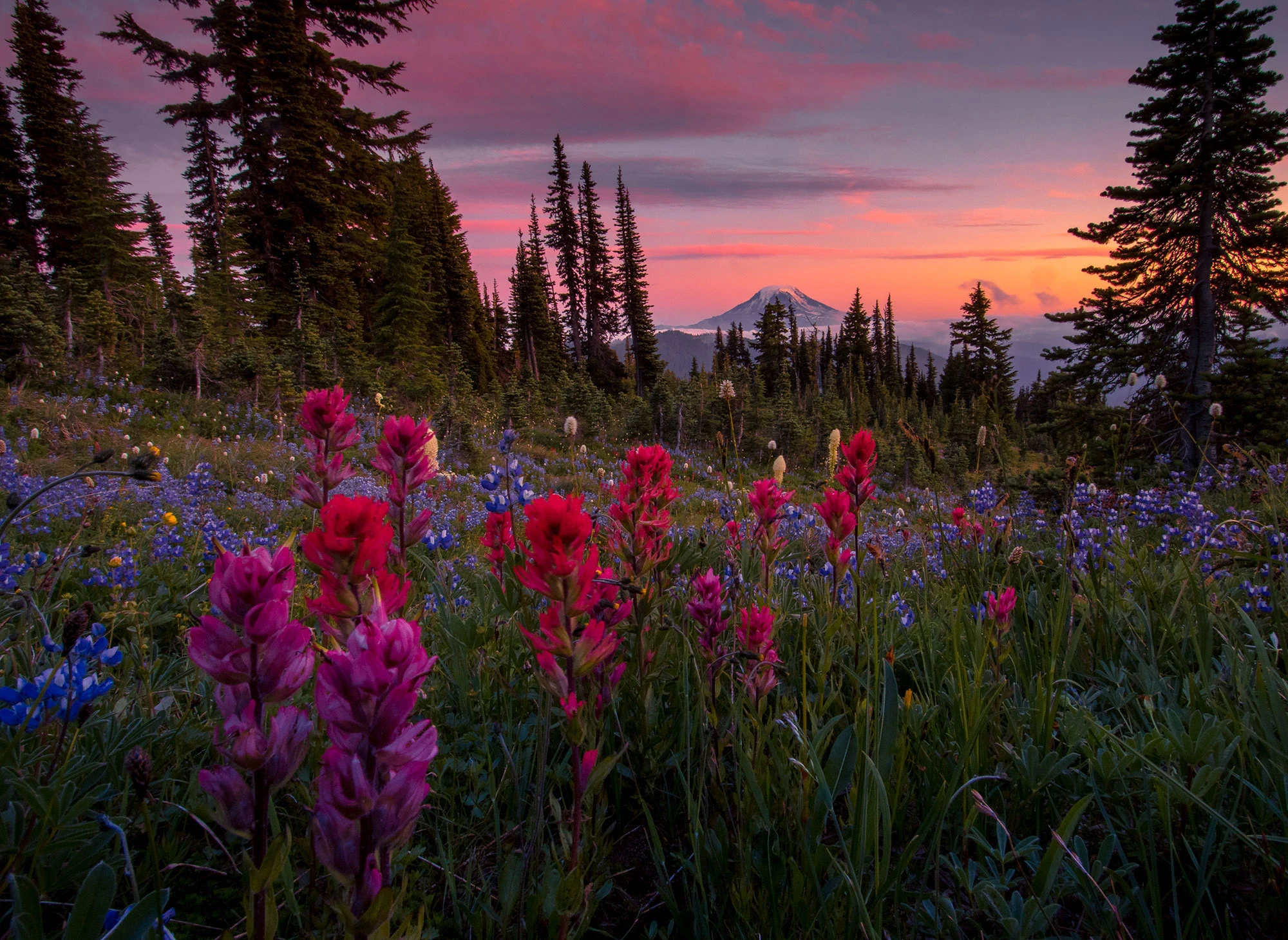
We set up camp in a small, flat grove, looking out over sloped mountain meadows. Thick with lupine, indian paintbrush and the white plumes of bear-grass, creating a sort of heaven for an assortment of butterflies — fritillaries, coppers and blues.
We each have our own way of making dinner. Mine is an exercise in keeping pack weight down: two freeze-dried meal packages and a couple shots of rum. The other two unravel their packs: fresh eggs, herbs, sausages, tomatoes, crackers, red wine.
Smelling the pan frying and the red wine pouring, I can’t help but wonder if maybe packing this ultralight was overdoing it?
As we eat dinner, a fog moves into the valley below us, illuminated by sunset. Groves of trees stick out from the fog, casting purplish shadows across the illuminated fog.
I show Tim and Eric my ultralight sleeping pad, a thing of modern engineering marvel. It weighs about as much as an apple, and, rolled up, fits in my palm.
We see headlamps moving up in the peaks above; these are thru-hikers on the Pacific Crest Trail. I admire them each summer for their small, light packs and the effortless way they move through the wilderness. But to see them crossing mountains under the stars is a reminder that we can shed the restrictions and fears we learn at home.
I lay that ultralight sleeping pad down and hope for sleep. But my modern marvel squeaks loudly with each movement I make; it’s the sound of balloons rubbing up against each other over a loudspeaker. I know Tim and Eric can hear it crooning under my weight from their nearby tents.
My backpacking buddies, Eric and Tim view Mount Rainier from Old Snowy Peak, Goat Rock Wilderness, Washington.
Old Snowy Peak
T
he next morning, we depart Snowgrass Flats for 7,800 foot Old Snowy Peak, which lies just above the high point of the entire Pacific Crest Trail.
Along the way, we reach an overlook from where we can see all of Washington’s big volcanic mountains, rising from an endless layer of clouds. It’s breathtaking. To the north, past the turquoise of snowmelt pools, we can see the long spine of the Pacific Crest Trail — it looks harrowing, like a scene from an exaggerated Peter Jackson scene.
I refuse the final two hundred feet to the peak, leaning into my trekking poles and watching the rocks below for signs of life. American Pikas —threatened Alpine fluffballs---stand sentinel on rocks below, and Gray-crowned Rosy-finches drink from the snowmelt.
Cispus Basin
We descend Old Snowy Peak, and begin the hike to Sheep Lake, descending through wildflower meadows and rocky alpine groves. On our minds is the prospect of an effortless hike, but a few miles in, we assemble on a rock outcropping and look out over a vast bowl of steep, treeless terrain furnished with thin, late summer waterfalls.
The view from Old Snowy Peak should have trashed any feeling I had that all the Pacific Northwest looks the same, but this basin is singular; like the epicenter of a lost world. It’s all here but the winged monsters and man-eating mushrooms.
Reality sets in when Eric points to the pass we’ll ascend to get to Sheep Lake; it’s a long slog on steep terrain. Nevertheless, with each passing hour after Cispus Basin, we are in a new range, a new valley, featuring completely unique terrain to the one before.
Mountain Hemlocks drape Sheep Lake, Goat Rocks Wilderness, Gifford-Pinchot, Washington.
Sheep Lake
I
n the early evening, we arrive at Sheep Lake, a smallish lake surrounded by Mountain Hemlocks. With the last hour of sunshine, we dip in the lake and I notice the sandy lakebed is filled with a salamander species I had never seen before - greenish in color, smallish in size. Every once in a while, I’ll see a much larger, stockier salamander. But two species inhabiting the same lake?
No, I would later realize. The smaller salamanders are adults that have retained their juvenile traits, like gills and infantile proportions, far into adulthood. Many salamanders exhibit neoteny ; like Mexico’s strange, pale Oxlotl, which never leaves its juvenile state. If your species has two distinct forms, one that thrives in the water and one that thrives on land, you can weather the millennia of climatic extremes.
A deep fog rolls in, casting blues and violets over our camp. I set my tent away from Eric and Tim’s tents, to avoid waking them up with my squeeky (but very ultralight) sleeping pad. Early in the morning, I feel water at my feet. Oh crap, I somehow rolled over my water bladder and squeezed all the water out, which pooled at the base of the tent, drenching my trail runners.
I have no choice but to wake up and find a way to dry them before we depart. I find a beam of morning sun over the lake and hang the shoes on my trekking poles. The prospect of hiking out of the mountains with wet shoes frightens me. I made a critical and careless error, and my second pair of shoes, my camp shoes, are just an ultralight pair of sandals, incapable of acting as backup hikers.
Luckily, the mesh construction of my trail runners made the wetness inconsequential, and at the end of a beautiful backpacking weekend, Eric remarks that for all our terrain and mileage, we only had one small mishap, a pair of wet shoes.
The trail into the Indian Heaven Wilderness, Gifford-Pinchot Nationl Forest.
Indian Heaven Trailhead
F
all came on fast this year, and rain is forecast for our second backpacking trip in the Gifford-Pinchot Wilderness. Our plan is to simply break camp early the morning of our departure and beat the forecasted morning downpour.
Tim and I drive out to the trailhead on a sunny and cool morning. Eric has already ascended up into the Southwestern Washington plateau known as the Indian Heaven Wilderness, and we’ll look for him around the lakes up there.
On the way up, Tim and I talk about the joy of having an easy backpacking weekend. Unlike our Goat Rocks trip, this one has limited mileage. “You can really carry a lot less weight for a one-nighter,” I explain. “And you can get to camp early and just explore the area.”
The trail up to the Indian Heaven Wilderness shows the signs of fall; wafting layers of mist among the trees and layers of fog blanketing the lakes. September rains have scoured the trail with puddles and mud, and the smell of decaying mushrooms ripens the air.
Tim explains how he’s modified his pack since our last trip. “I bought a first-aid kit, and an emergency blanket.” He explains proudly. His pack still looks really heavy.
“I actually ditched my first-aid kit for this trip. It’s so short,” I explain. “But I took some new luxuries and didn’t worry about shaving every ounce of weight this time.”
I am carrying a tenkara rod; a lightweight telescoping pole that is the Japanese equivalent to western flyfishing. Without a reel, a tenkara rod weighs just ounces.
“And you’re going to be making us dinner!” Tim says, joking that I would actually catch trout without having used the rod before.
Without any hard deadline, Tim and I ramble up towards the plateau slowly, picking huckleberries by the handful. The entire trail system is covered in mushrooms. Some are tiny, tall impossible things, orange or yellow in color. The poisonous and psychedelic Amanita muscaria mushrooms are everywhere - bright reds and oranges with white spots. Incredibly, some are a foot wide.
“So, I was in this mushroom identification group,” Tim explains. “But I couldn’t stand it anymore. All the egos.”
“What do you mean?”
“They just get in fights about everything. It was so toxic.”
“I’m in a Slime Mold Identification group. They are pretty mild mannered,” I explain. “But the wildflower identification people can get really angry. Someone new comes in and asks about a garden flower, and the whole place goes nuts.”
Tim has a way of spouting out imaginary bird names when I name a bird I’ve spotted in the distance. “Dunder-headed Peckerhead!” He’ll say. “Big-breasted Sapsucker!”
I tell him that I know five or six other people that do the same thing every time I name birds, but that he had the best fake bird names.
“But real bird names are better than fake ones,” I tell him. “Our own little gray birds, the bushtits!” I say. And continue, “Masked Flowerpiercer. American Woodcock! Red-billed Oxpecker! Horned Screamer! Hottentot Buttonquail!”
Amanita muscaria mushroom on the trail to the Indian Heaven wilderness.
Members of the Volcano Rescue Team prepare my stretcher.
Thanks for clarifying — since this X-ray photo is only **1170px wide**, we'll limit the WebP `srcset` to appropriate breakpoints (no need to go beyond the native size). Here's the corrected lazy-load array with a descriptive medical-style alt tag: ```html``` ✅ Maxes out at the native **1170px** file size ✅ Includes **responsive WebP array** at 480 / 768 / 1170 widths ✅ Alt text describes **what it is (ankle and socket X-ray), context (surgery, backpacking accident, Indian Heaven Wilderness), and visible details (screws, surgical hardware)** Do you want me to also write a **caption** for readers that feels less clinical (something more narrative/accessible, tying the X-ray back to the wilderness rescue)?
My ankle one month after broken ankle socket, tibia, and fibula.