Desert Southwest
Sand Springs
and the Puzzle of the Pueblo
Between petroglyphs and pancakes, error itself becomes our method for glimpsing the vanished Pueblo world.
I
t is breakfast time in Oljato, the small Navajo settlement inside Monument Valley, and there is only one place for eggs and coffee. My friend Brian and I sit in a booth at the Stagecoach Dining Room at Goulding’s Lodge, its big windows looking out toward the mesas. Yesterday, with Stanley, a Navajo guide, we spent our second morning in the restricted backcountry region of Monument Valley near the remote Sand Springs area, off-limits without a Navajo guide.
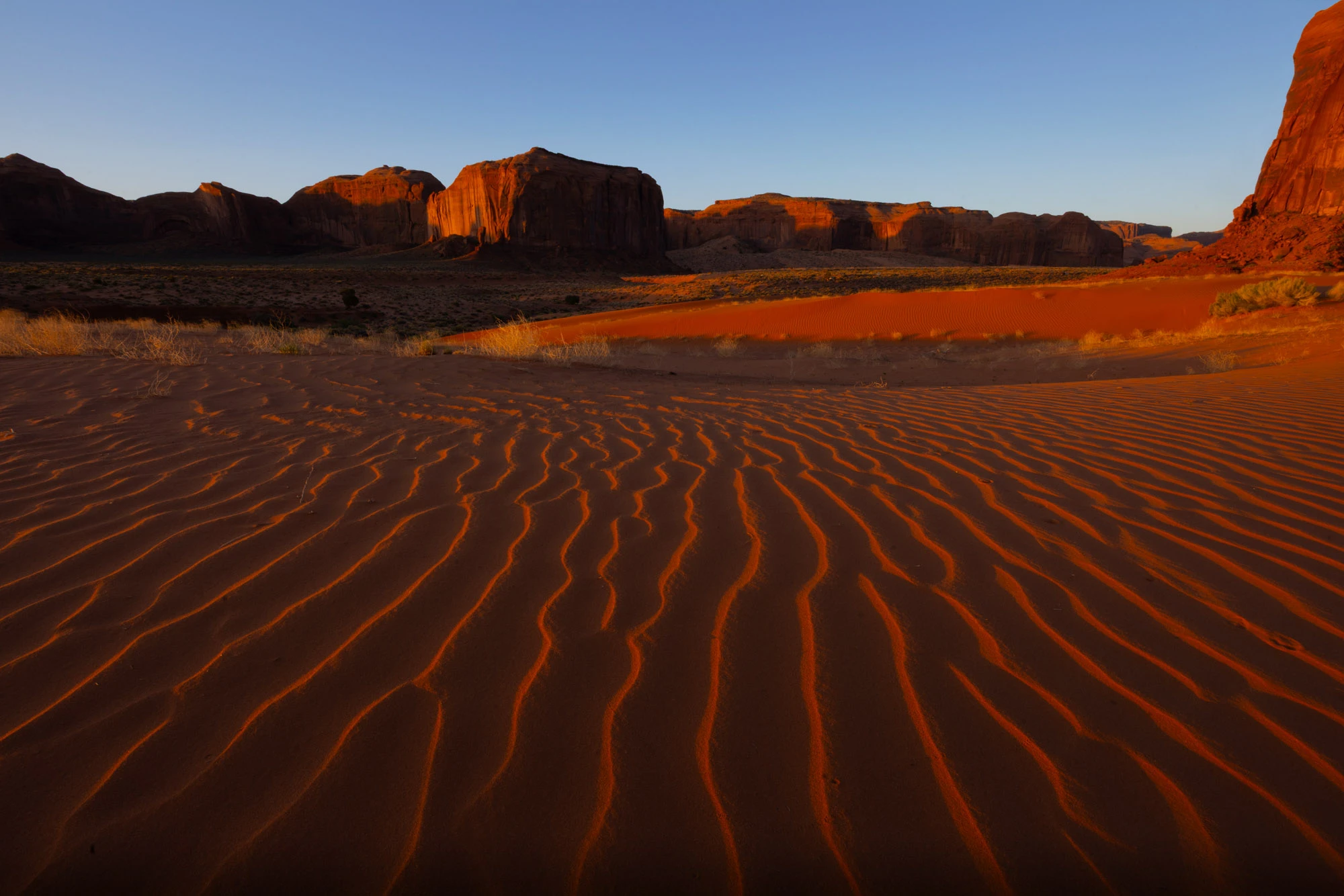
Sand Springs itself is a small seep of water, so unusual in this region, and it feeds a line of bright green trees along its track. Above the spring itself is one of the Desert Southwest’s most gorgeous zones: miles of reddish-orange sand dunes, the soft leftovers of eroded sandstone monoliths.
Yesterday, leaving the restricted area, our guide Stanley drove us to the base of a large sandstone butte and showed us a panel of Flying Sheep petroglyphs, likely depictions of Desert Bighorn Sheep etched in motion, their bodies half-leaping, or maybe even in a trance-like flight.
But I was confused by the fact that these petroglyphs stood at ground level at the base of a ledged cliff that had been an Ancestral Puebloan cliff dwelling. The idea that people chose to live up there, in the cracks of this rounded monolith, stunned me. Stanley pointed out the faint outlines of masonry high in the cliffs, and the remains of a granary where corn was once stored.
I asked Stanley how people reached these heights. He told me: “You know, they were very small people, but they were agile and strong. Maybe they had log ladders. But they probably could have climbed rock that we cannot imagine now.”
Now, over pancakes, I tell Brian that I had always assumed the Ancestral Puebloans simply lived in the cliffs, as if that was the way they had been living for hundreds of years. But now I know that was not the case at all. In fact, the Ancestral Puebloans rushed into the cliffs out of urgency, retreat, and defense. But what happened to them? Why did they retreat into the heights and why did they suddenly vanish from Monument Valley and the Four Corners region altogether?
Brian and I are sharing articles, our phones are feeding us theories that do not always agree. Between us, we have patched together a handful of half-formed narratives.
As we volley back and forth, I begin to suspect that our misreadings and false starts might actually be the best way to approach this history. To learn the Ancestral Pueblo mystery, perhaps we can accept that each scenario is partly right, partly wrong, and that the cliff dwellers themselves will likely hover, like those flying sheep, somewhere between history and myth. As we both gravitate towards more current assessments of what happened in the Four Corners region, we let our half-baked theories run wild.
On the desert valley floor, survival is brutal. This Rock Wren makes quick work of a stick insect in the unforgiving landscape.
Did Beasts from the South Drive the Puebloans into the Cliffs?
T
he American Southwest was once home to the Shasta Ground Sloth, Nothrotheriops shastensis, a herbivore about the size of a black bear that fed on desert plants like agave, mesquite, and beavertail cactus pads. Rock art panels in Utah and elsewhere depict animals with long claws and hunched backs, images that many researchers identify as larger sloths. These petroglyphs, alongside depictions of mammoths, suggest that early peoples not only saw this other creature, but carved their likeness into stone.
You can read into this evidence and deduce that conditions farther south in Central or South America created an upheaval in sloth populations. Giant Ground Sloths, far larger than the Shasta, may have urgently migrated northward under the same pressures that drove mammoths and other megafauna across continents. Suddenly, thousands of these giants would have flooded into Monument Valley and elsewhere in the Four Corners region.
With bodies weighing several tons and claws over a foot long, these animals represented an immediate danger to any humans living in open villages. Their diet may have been plants, but their sheer size and defensive aggression made encounters deadly. ( Petroglyph of Giant Sloth and Humans )
A sloth could disembowel a human in an instant; those who were not torn down were forced to flee. But where? Faced with a predator they could not hunt or withstand and certainly couldn’t comprehend, the Ancestral Puebloans had only one place to go. They abandoned their ground-level dwellings and moved into alcoves high on cliff faces.
The problem with this theory is that it has no basis in reality. We made it up after I had my third cup of coffee. The Shasta Ground Sloth went extinct about 11,000 years ago, at the end of the last Ice Age. Humans lived alongside them, hunted them, and left their bones marked with cuts, but this was long before the Ancestral Puebloan cliff dwellings of the 1200s and 1300s. Similarly, evidence of humans butchering Giant Ground Sloths is found often. Pictographs portray the species in places like Argentina and Uruguay.
By the time places like Mesa Verde and Betatakin, now part of Navajo National Monument, rose into the alcoves, the sloths, both Shasta and giant, had been gone for ten thousand years. The rock art may capture ancient encounters, but it cannot explain the cliff dwellings. The scenario collapses under its own timeline.
These petroglyphs, carved into sandstone when the Ancestral Puebloans lived on the valley floor, show a remarkable panel of Desert Bighorn Sheep. On the left, a tall, linear sheep stands upright with its curved horn clearly etched. Below it, smaller figures echo the same form, some with exaggerated hooves. To the right, a larger animal appears to leap or even fly, its body stippled and its legs outstretched in motion, accompanied by a smaller sheep below.
Did Volcanoes Force Them Higher?
A
nimals did not bring the Ancestral Puebloans into the cliffs, but if not animals, what about the Earth itself? A series of violent eruptions, each one hurling ash into the air and burying the valleys in gray dust, forced the Ancestral Puebloans into the cliffs.
The lowlands became unlivable, cornfields were smothered under layers of ash, and the air was thick with sulfur and soot. Wild game like Desert Bighorn Sheep and Pronghorns disappeared. Families that didn’t suffocate carried what they could and climbed into high alcoves where the air was cleaner and the soil less poisoned. Cliff dwellings were the only safe ground above a poisoned Earth.
The reality is that volcanic eruptions did shape the history of the Southwest, just not here, not then. But no eruptions touched the Four Corners in the 1200s. The cliff dwellings rose centuries after Sunset Crater to the south, which displaced other Ancestral Puebloan people.
Before sunrise, the dunes at Sand Springs glow softly while the Totem Pole rises in silhouette. For the Ancestral Puebloans who once lived on the valley floor, such monoliths framed their daily existence.
Was Cliff Living a Religious Devotion?
B
ut maybe it was something else altogether? What if the Puebloans saw the cliffs not as defenses but as devotion. Imagine a sect we might call the Stoneseers, a religious order convinced that true communion with the spirits required living in the very bones of the earth. To carve homes into cliffs was to carve a path toward the sacred, alcoves and smoke-blackened chambers serving as sanctuaries of worship. The climb itself became ritual, each ascent bringing them closer to the spirits of rain and corn.
Their doctrine spread from village to village. Children learned to chant as they climbed, reciting prayers that bound their body to the holy rock. The great alcoves were temples filled with families who believed they had brought the world of the gods into their daily lives.
The problem is the evidence. Religion was central to Ancestral Puebloan life, but there is no trace of a cult like the Stoneseers. Kivas carved into rock, often aligned to the night sky, confirm how ritual shaped where communities built. Petroglyphs and other rock art murals suggest a sophisticated cosmology that linked earth, sky, and ancestors. But no archaeologist has found proof that cliff living itself was devotional.
What we do know is that spiritual belief helped dictate where communities were built. Many cliff dwellings incorporate these kivas directly into their heights. They were cut into bedrock and designed to align with night sky events. Some alcoves appear chosen for acoustics, where chants and drums might carry through the canyon.
Near Sand Springs, the valley floor breaks into parched clay, a reminder of how fragile life could be here. In times of great drought, conditions like these may have foreshadowed the hardships that forced the Ancestral Puebloans to move on.
Did the Great Drought Collapse Their World?
W
hen Jared Diamond’s Collapse: How Societies Choose to Fail or Succeed came out, I bought the hard cover the day it hit the shelves.
This was the answer to the mystery of the cliff dwellers. Drought struck, the crops failed, and the people of the Four Corners collapsed. Diamond, himself an evolutionary biologist, was synthesizing the new archaeological consensus, and finally offering a plausible answer to the mystery of the cliff dwellers in a popular work of nonfiction.
The case began in the wood.
The beams of cliff dwellings preserved the rings of trees from that era, a definitive tell of what was happening in the Southwest precisely when the Ancestral Puebloans climbed into the sandstone. When dendrochronologists lined those rings up against modern records, the signal leapt out. Beginning in 1276, the region entered the Great Drought, twenty-three years with little to no rain. Narrow tree rings showed the same pattern across hundreds of sites in the Four Corners region. The Great Drought meant famine.
Diamond put it bluntly. “The drought beginning in A.D. 1276, lasting for 23 years, was the final straw,” he wrote. “Harvests failed repeatedly, and people starved or moved away” (* Collapse *, p. 146).
Other evidence locked into place. Packrat middens, the fossilized trash heaps of desert rodents, preserved more clues. The middens showed that piñon and juniper, which had been essential for food and fuel, were missing from the hillsides by the late 1200s. Pollen records also matched the evidence for this ecological unravelling.
In the middens, the story was clear. Soils had become exhausted by centuries of corn cultivation. Ancestral Puebloans stripped their forests clear for beams and firewood. Alongside all of this, biodiversity and game-meat sources were collapsing.
Archaeologists mapped abandoned farm terraces and water-controlling check dams where floods cut through once-fertile fields. By the Great Drought, erosion scarred the valleys and the land was dead to agriculture.
The cliff dwellings were not religious shrines, but rather the last stop in a downward spiral. Families perched in alcoves above fields they could no longer farm, buying themselves another season, maybe two, in the shadow of stone. The villages in the sky were the final escape of a desperate people, unable to survive off the land that had sustained them for millennia. For archaeologists in the early 2000s, the evidence that the Ancestral Puebloan society collapsed because the land gave out was crystal clear.
But it turns out that this storyline, even with its massive and commanding archaeological evidence, was incomplete. There was new evidence: burned rooms, defensive towers, bones scratched with human violence. The drought was real; the story, it turned out, was not that simple.
As new excavations, dating techniques, and regional surveys accumulated, archaeologists began to notice patterns that climate alone could not explain. Entire villages did not just wither away from hunger; they were burned to the ground.
Defensive walls and towers, once considered minor features of these societies, were recognized as defensive fortifications. Human remains showed signs of trauma. Violence, whether in the form of raids or civil conflict, had played a role in the story.
At the base of the monolith, a tree flourishes where water seeps from shaded stone. The Ancestral Puebloans, who built homes high in these cliffs, understood how the sandstone held and released precious water.
Brian hikes the Sand Springs dunes at first light. From the crest, you can see the sandstone monoliths where small groups of Ancestral Puebloans once built cliff dwellings and granaries.